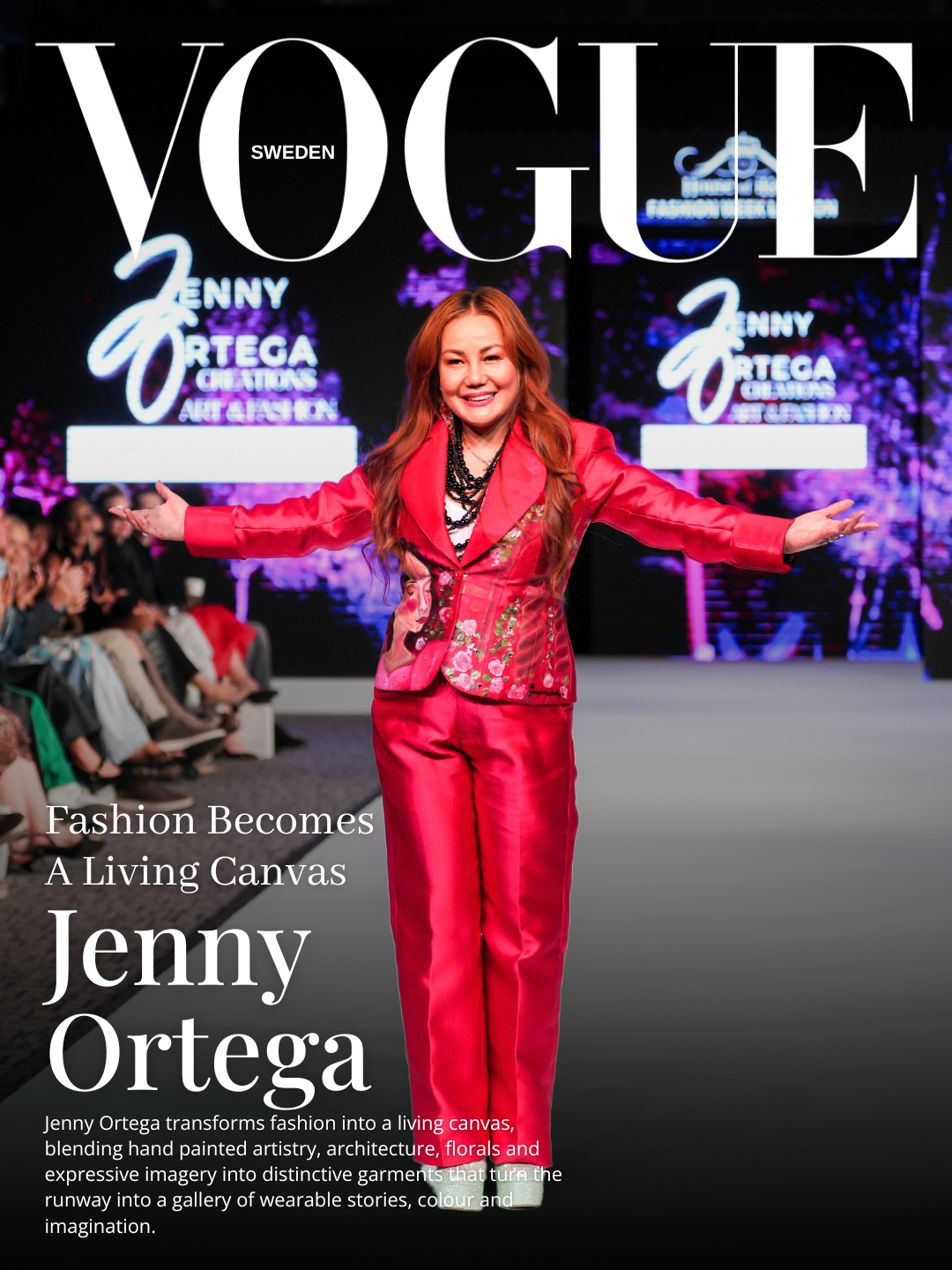
Fashion has always existed somewhere between design and art, but Jenny Ortega Collections explored that relationship with an especially expressive point of view at House of iKons Fashion Week London. Rather than treating clothing simply as garments designed to be worn, Ortega approached each piece as a visual composition, transforming fabric into a canvas for architecture, florals, figures, landscapes and stories.
The result was a collection that felt personal, artistic and highly visual. Every look appeared to carry its own identity, inviting the audience to look beyond the silhouette and discover the imagery contained within it.
Presented during House of iKons Fashion Week London, the collection demonstrated how fashion can become a medium for artistic storytelling. Ortega’s work brought together elements of painting, architecture and contemporary design, creating pieces that occupied a space between wearable fashion and artwork.
When Fabric Becomes a Canvas
The defining characteristic of Jenny Ortega Collections was the hand-painted aesthetic that ran throughout the presentation.
Instead of depending primarily on conventional prints, sequins or surface embellishment, Ortega used garments as spaces for artistic expression. The fabric became a blank canvas, allowing images to interact with the movement and structure of each silhouette.
This approach immediately gave the collection a distinctive character.
Flowers stretched across fabric. Buildings appeared within carefully composed scenes. Figures and portraits created moments of human expression, while architectural imagery introduced a sense of place and atmosphere.
The artwork was not simply added to the garments as decoration. It became part of their identity.
A dress could therefore communicate something before the wearer even moved. A jacket could suggest a city. A floral composition could establish an emotional atmosphere. A portrait could introduce a sense of mystery.
The clothing became visual storytelling.
Architecture Meets Fashion
Architecture played an important role in Ortega’s creative vocabulary.
Buildings and city scenes appeared across several garments, introducing a sense of structure and place. Their presence created an interesting contrast with the softness of flowing fabrics and floral imagery.
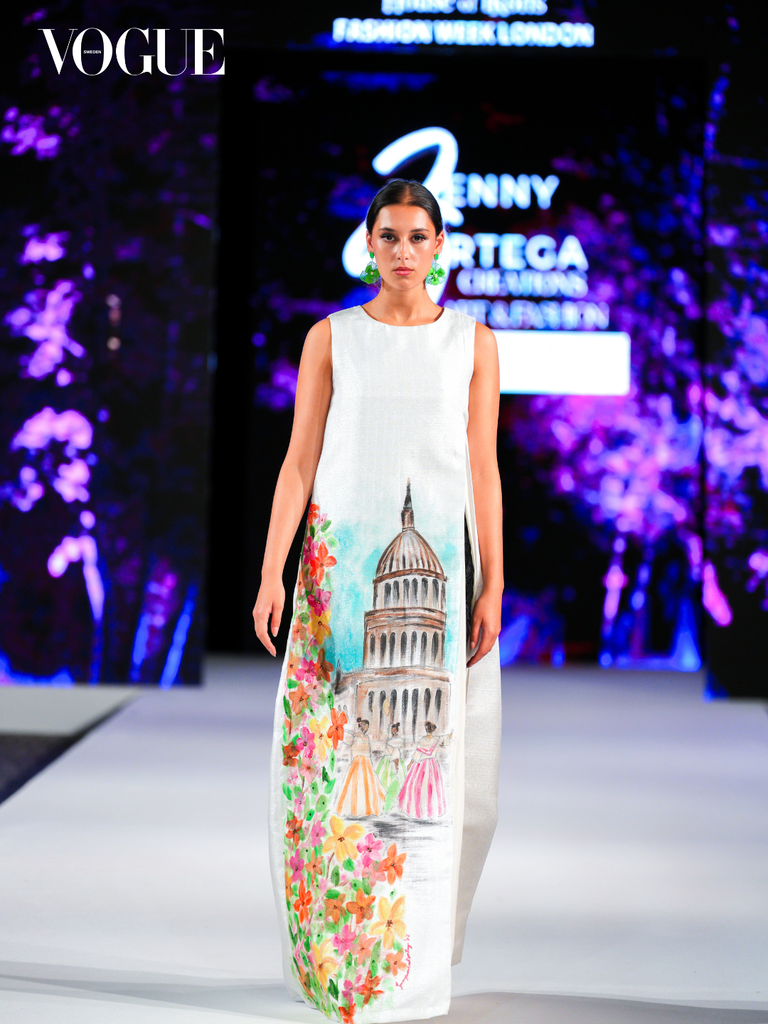
One particularly striking white sleeveless dress demonstrated this balance. Its light background created an open space for an elaborate architectural scene, surrounded by cascading flowers in shades of orange, pink and green.
The composition transformed the dress into something resembling a moving painting.
As the model walked, the artwork moved with her, changing subtly with every step. The architectural imagery remained recognisable while becoming part of the natural movement of the garment.
It was a reminder that fashion has one quality that traditional artwork does not.
It moves.
A painting remains fixed on a wall, while a fashion illustration can travel through a room, interact with light and movement, and become part of the person wearing it.
Ortega’s collection embraced that unique quality.
The Language of Colour
Colour became another important storytelling tool throughout the collection.
The brighter looks introduced vivid shades that immediately attracted attention. Orange, pink and green florals created an energetic contrast against lighter backgrounds, giving certain garments an optimistic and almost dreamlike quality.
The collection then moved into darker visual territory.
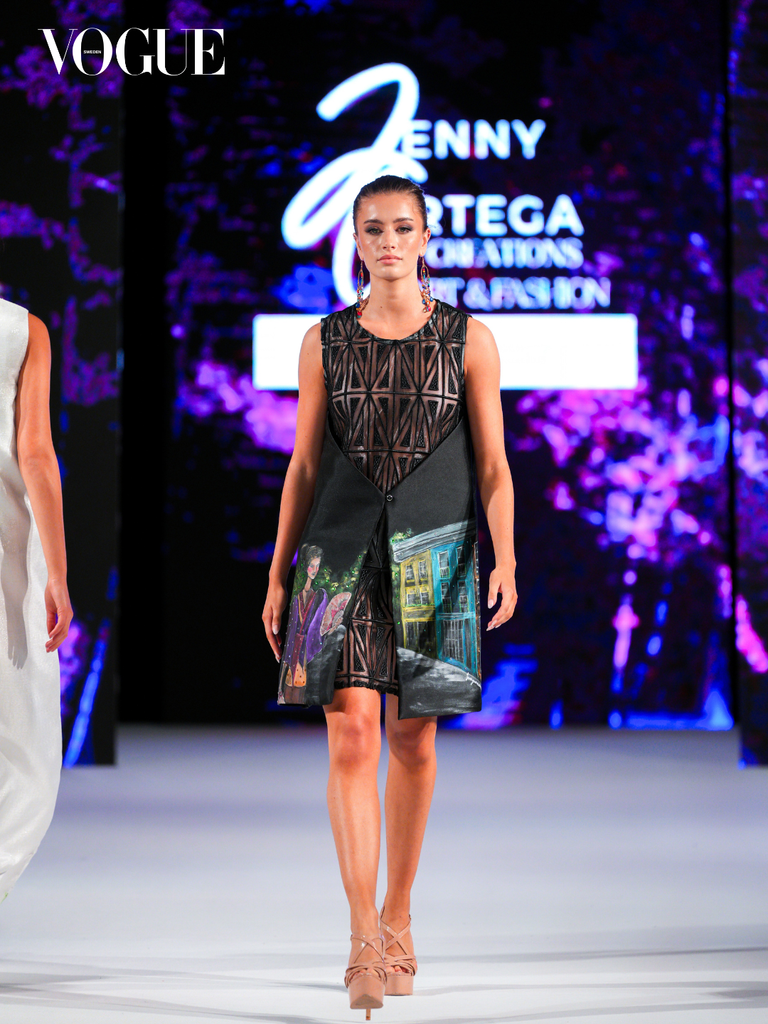
Black garments featuring atmospheric city scenes and portraiture created a different mood. These pieces felt more dramatic and contemporary, demonstrating Ortega’s ability to explore contrasting emotional landscapes within one collection.
The transition between light and dark imagery prevented the presentation from feeling visually predictable.
Instead, each look contributed another chapter.
Some garments felt romantic. Others appeared mysterious. Some celebrated nature, while others were rooted in the energy of urban environments.
The result was a collection that could not easily be reduced to one mood.
Feminine Expression with Contemporary Edge
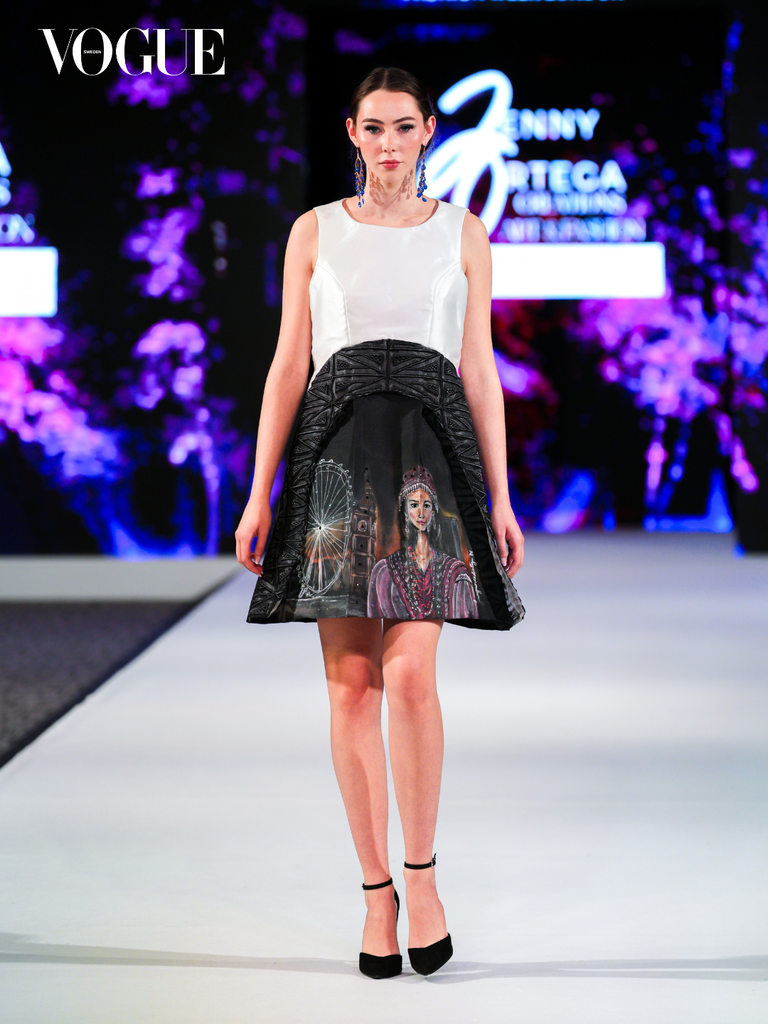
Although artistic imagery was central to the collection, Ortega did not allow the artwork to overwhelm the fashion itself.
Silhouette remained important.
Flowing dresses created movement and femininity, while structured garments introduced sharper lines and a more contemporary attitude.
This balance was particularly visible in a sculptural monochrome dress combining a crisp white bodice with a dramatic black skirt. Its contrasting structure created a powerful foundation for the artwork, allowing the imagery to become an unexpected focal point.
The look demonstrated that artistic fashion does not necessarily require extravagance.
Sometimes, the strongest visual impact comes from contrast.
White against black.
Structure against movement.
Minimalism against detailed imagery.
Ortega understood these contrasts and used them to create garments that felt visually sophisticated without losing their expressive quality.
Art Beyond Womenswear
The artistic language of Jenny Ortega Collections was not restricted to womenswear.
Menswear also became part of the collection’s visual narrative, demonstrating the flexibility of the designer’s approach.
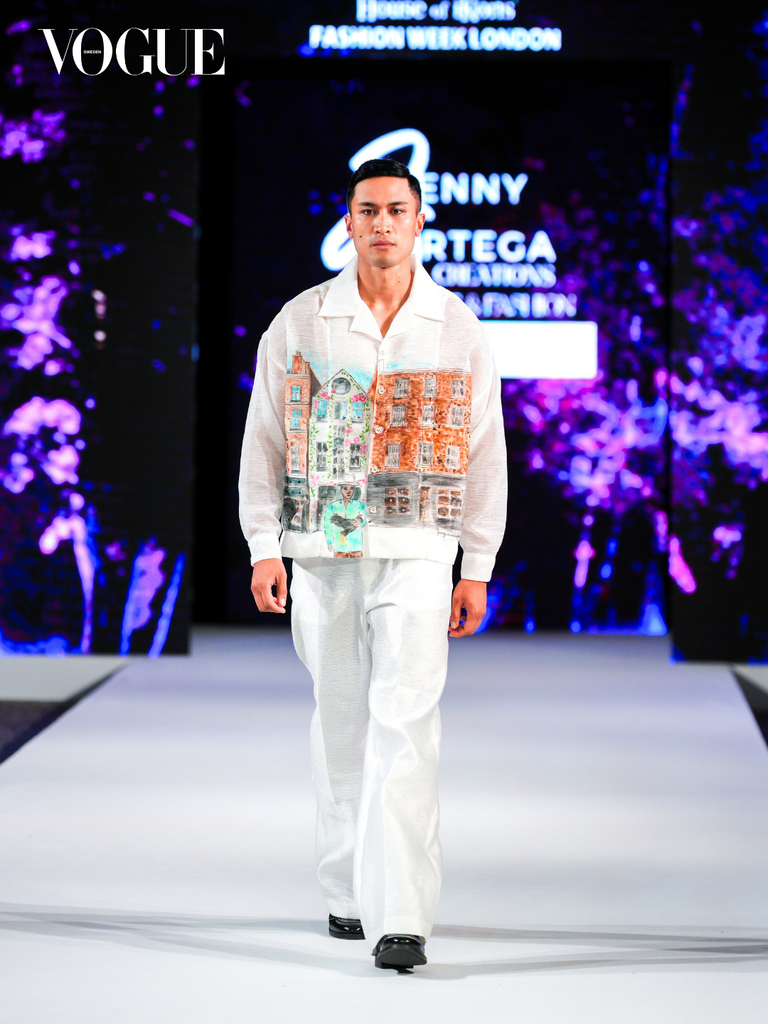
A relaxed white ensemble featuring a cityscape across the jacket translated Ortega’s artistic vocabulary into a different silhouette and styling language.
The result felt contemporary and effortless.
The cityscape became the central visual element, while the relaxed structure of the outfit allowed the artwork to remain prominent without making the garment feel overly formal.
This demonstrated an important quality of the collection: the artwork was capable of adapting.
Whether presented on a flowing dress or a structured jacket, the imagery remained central to the identity of the design.
Fashion as Storytelling
There was a strong narrative quality throughout the presentation.
Buildings suggested places.
Flowers suggested nature and emotion.
Portraits introduced human presence.
Landscapes created atmosphere.
Together, these elements transformed the collection into something resembling a visual journey.
This is one of the most compelling aspects of Ortega’s work. Rather than creating garments that exist independently of one another, she established a creative language that connected the collection.
Each piece could be appreciated individually, but viewed together, the garments formed a larger artistic conversation.
That approach gives audiences something to discover.
Fashion shows are often experienced quickly. A model walks onto the runway, an audience observes the silhouette and styling, and within moments another look appears.
Ortega’s designs encourage a different kind of attention.
The audience is invited to look closer.
What is depicted on the garment?
What story does the image suggest?
How does the artwork interact with the silhouette?
How does the garment change when the model moves?
These questions make the viewing experience more engaging.
The Artist Behind the Garment
At the heart of the collection is a clear respect for artistic craftsmanship.
Hand-painted fashion requires patience and precision. Unlike conventional mass-produced prints, painted imagery carries a sense of human touch.
There can be subtle variations, expressive brushwork and a feeling that the artwork was created specifically for the garment.
That human quality complements Ortega’s storytelling approach.
The clothing feels less like something produced simply to follow a seasonal trend and more like something created to communicate an idea.
This distinction is significant in an industry where trends can move rapidly.
Artistic identity gives a collection longevity.
A trend may become outdated, but a compelling image or meaningful artistic concept can continue to resonate.
The House of iKons London Stage
The House of iKons Fashion Week London runway provided a fitting platform for Ortega’s artistic presentation.
Known for bringing together designers with distinctive creative perspectives, the event created an environment where fashion could be presented as a form of individual expression.
Within that setting, Jenny Ortega Collections stood out through its connection between painting and design.
The runway became a moving gallery.
Instead of paintings hanging on walls, the audience experienced artwork through garments, models and movement.
That relationship between the artwork and the runway environment gave the collection additional energy.
Lighting, music, movement and presentation transformed the pieces from static designs into an immersive visual experience.
A Collection That Crosses Boundaries
Perhaps the strongest quality of Jenny Ortega Collections is its ability to exist between categories.
It is fashion, but it also carries the language of painting.
It is wearable, yet it possesses the visual qualities of artwork.
It draws from architecture, but it remains deeply connected to the human body.
It can feel feminine and romantic in one moment, then structured and contemporary in another.
These contrasts make the collection difficult to place within a single category, and that is precisely what makes it compelling.
Ortega does not appear interested in limiting fashion to one definition.
Instead, she demonstrates how clothing can become a meeting point for multiple creative disciplines.
The Power of Individuality
In an increasingly fast-moving fashion landscape, individuality has become one of the most valuable creative qualities a designer can possess.
Jenny Ortega Collections demonstrates a willingness to build an identity around artistic expression rather than simply following established formulas.
The garments feel designed to be remembered.
They invite conversation.
They encourage interpretation.
Most importantly, they allow the wearer to become part of the artwork.
That relationship between garment and wearer is essential. A beautiful design exists differently once it is worn. The person brings movement, personality and presence to it, while the garment becomes an extension of their expression.
Ortega’s designs create an especially strong opportunity for that interaction.
Where Fashion Becomes Art
Jenny Ortega Collections’ presentation at House of iKons Fashion Week London ultimately celebrated an idea that has always existed at the heart of great fashion: clothing can communicate.
It can communicate a mood, a memory, a place or an emotion.
It can reference architecture, celebrate nature or capture the human figure.
It can make the wearer feel elegant, powerful, artistic or completely different from how they felt before putting it on.
Ortega’s collection embraces that potential.
Through hand-painted imagery, expressive colour, architectural references and distinctive silhouettes, she created a visual language that transformed garments into individual works of art.
The collection demonstrated that fashion does not have to choose between being beautiful and being meaningful.
It can be both.
A dress can become a painting.
A jacket can become a cityscape.
A floral design can become a memory.
And a runway can become a moving gallery.
Jenny Ortega Collections showed that when creativity is allowed to cross boundaries, fashion becomes more than something we wear.
It becomes a canvas, a story and ultimately, a work of art.
Event Credits
Event: House of iKons Fashion Week London
CEO/Producer: Savita Kaye
HMUA/Sponsor: MadeupbySamuel
Staging: Ambassadors of Sound
Location: Leonardo Royal Tower Bridge London Hotel
Sponsors: The Fashion Life Tour, Bronze Me Baby, True Goddess, Spraga
Images courtesy of: Josh Rosales Photography, Iain Atkins & Kevin Blake