
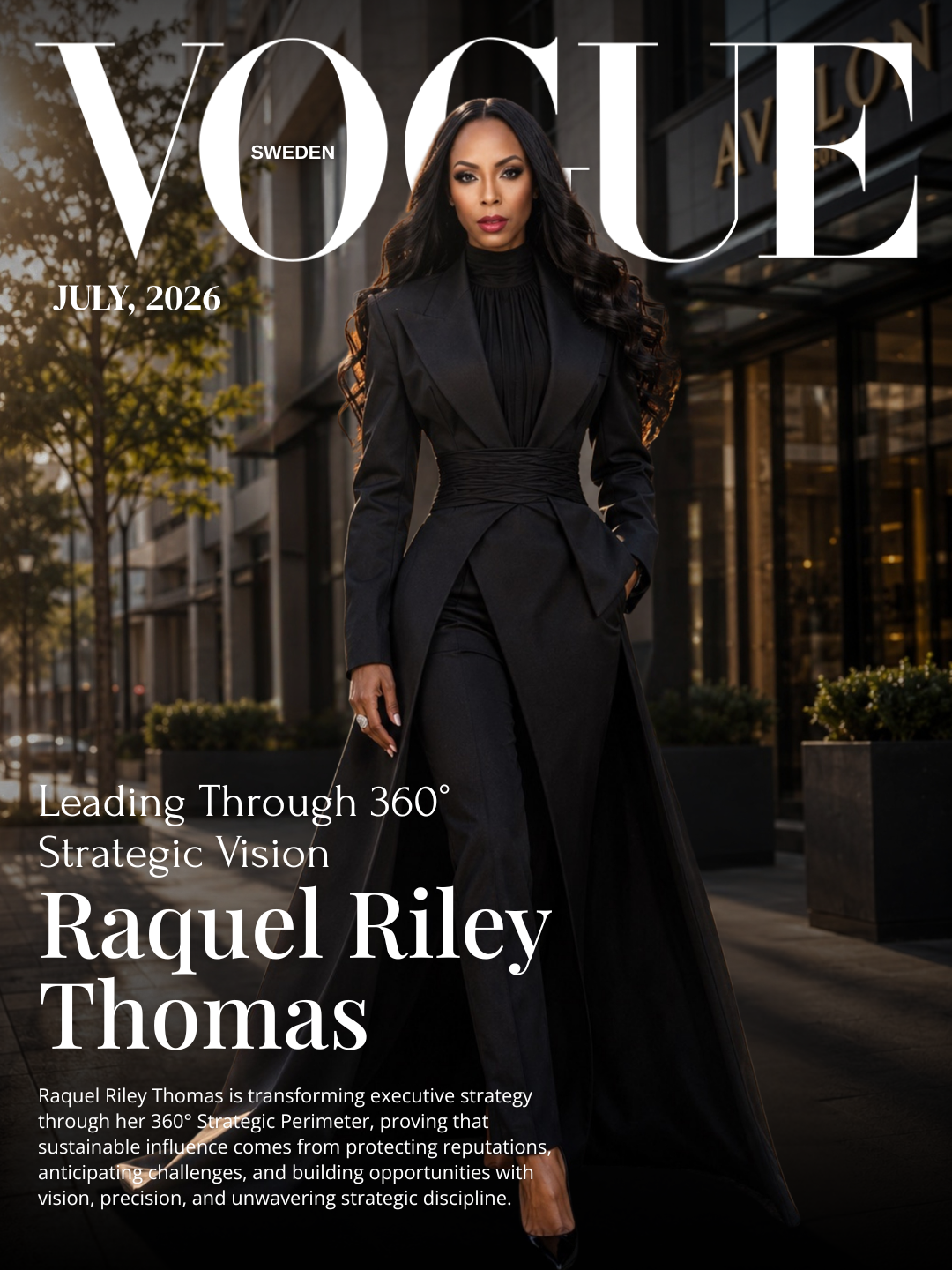
Why the Executive Strategist Is Redefining How Leaders Build, Protect, and Expand Their Influence
Written by Eve Brooks
There is an unmistakable difference between executives who react to opportunity and those who architect it. The former spend their careers responding to circumstances as they unfold, hoping that talent, timing, and perseverance will be enough to carry them forward. The latter devote equal attention to anticipation, recognizing that the most consequential decisions are often made long before the public ever witnesses the outcome. Raquel Riley Thomas belongs firmly to the second category. Her career has never been defined by an appetite for attention, but by an almost instinctive inclination to anticipate what others overlook. To understand her philosophy is to understand that she is rarely focused on the move immediately in front of her. She is already evaluating the implications of the next several moves and asking herself a question that has become central to everything she does: What has everyone else failed to consider?

That question has quietly become the foundation of her work as Founder and Chief Executive Officer of An Officer and Gentlewoman, LLC (AOAGWLLC), a global firm whose divisions include executive strategy, brand management, talent management, production, and public relations. Yet describing Thomas by the services her firm provides would be an incomplete portrait. Her clients are not simply engaging an executive strategist to negotiate opportunities or strengthen their public profiles. They are inviting someone into the most consequential decisions surrounding their careers, businesses, reputations, and long-term aspirations. They trust her not because she promises publicity, but because she approaches every engagement through a framework that is both methodical and uncommon. It is a philosophy she describes, almost instinctively, as maintaining a 360-degree view of the entire landscape.
The origins of that philosophy can be traced to her military service, though not in the way one might expect. Many veterans speak about discipline, leadership, or resilience. Thomas certainly possesses those qualities, but they are not what distinguish her thinking. The lesson that endured most profoundly is operational awareness. In military environments, no commander can afford to become consumed by a single objective while ignoring the perimeter surrounding it. A vulnerability left unprotected rarely remains isolated. It becomes the point through which every other strength can be compromised. Years after leaving the Army, Thomas realized she had never stopped evaluating people, organizations, and opportunities through that same lens.

When she meets with a client, she is not immediately thinking about magazine covers, keynote addresses, endorsement agreements, or television appearances. Those opportunities matter, but they arrive later in her process. Her first instinct is to conduct what she describes as a strategic assessment of the entire perimeter. She wants to understand where the client’s vulnerabilities exist before discussing expansion. Is their biography communicating executive authority? Does their digital presence reinforce the reputation they hope to cultivate? Are contracts adequately protecting their intellectual property? Have they diversified revenue streams, or are they overly dependent upon a single source of income? Does their public image accurately reflect the level at which they intend to compete? Are there unseen liabilities capable of undermining future negotiations?
To Thomas, these questions are not peripheral. They are foundational. Growth without protection has never impressed her. In fact, she believes that visibility achieved without strategic preparation frequently creates unnecessary exposure. “A brand is only as strong as the perimeter protecting it,” she often explains, a philosophy that has gradually become one of the defining characteristics of her advisory work. While much of the business world celebrates acceleration, Thomas has built her reputation by insisting upon thoughtful preparation before expansion. Her clients may initially arrive seeking opportunities, but they often leave with something considerably more valuable: a disciplined framework for evaluating every significant decision they will encounter moving forward.

This approach is perhaps best understood through the concept she has quietly developed over years of experience: the 360° Strategic Perimeter. Rather than viewing executive strategy as a sequence of disconnected services, Thomas sees every component of a client’s professional life as part of an interconnected ecosystem. Executive positioning influences negotiations. Negotiations affect enterprise value. Enterprise value shapes partnerships. Partnerships impact reputation. Reputation determines credibility, and credibility ultimately governs opportunity. None of these variables exist independently. Every decision reverberates throughout the entire system, strengthening or weakening the client’s long-term position.
That systems-oriented perspective explains why Thomas often asks questions that initially surprise those sitting across the table. While others are eager to discuss immediate opportunities, she is interested in the assumptions beneath them. Why is this opportunity attractive? What objective does it actually accomplish? What obligations accompany it? What possibilities might it inadvertently eliminate? If circumstances change twelve months from now, does this decision still strengthen the client’s position? These inquiries are not intended to complicate the conversation. They are designed to ensure that today’s excitement does not become tomorrow’s regret.
Her academic background in psychology complements this methodology in significant ways. Thomas has long believed that successful negotiations are shaped less by information than by human behavior. Every agreement, every partnership, and every strategic decision is influenced by perception, incentive structures, cognitive bias, emotional intelligence, and the subtle dynamics of trust. Consequently, she spends as much time understanding how people think as she does analyzing contracts or evaluating market opportunities. The result is an advisory style that feels less transactional and considerably more diagnostic. Before recommending solutions, she seeks to understand the patterns of thought producing the challenges in the first place.
Those who work alongside Thomas frequently observe that she possesses an unusual tendency to anticipate complications before they materialize. She does not regard this as intuition. She regards it as preparation. While many executives celebrate a successful negotiation and immediately shift their attention elsewhere, Thomas begins considering the implications of that success almost immediately. Every victory introduces new variables. Every expanded platform creates additional responsibilities. Every meaningful partnership alters future negotiating positions. Success, in her view, is never a conclusion. It is simply the beginning of a more complex strategic landscape.
This way of thinking has become increasingly valuable as modern careers grow more multidimensional. Today’s entrepreneur may simultaneously serve as a chief executive, investor, author, philanthropist, media personality, and content creator. Public visibility, intellectual property, organizational leadership, and financial strategy now intersect in ways that did not exist a generation ago. Thomas recognized early that managing these complexities required more than traditional consulting. It required an integrated philosophy capable of examining every element collectively rather than individually. The 360° Strategic Perimeter emerged as her response to that reality.
Perhaps what distinguishes Thomas most is her refusal to confuse attention with influence. In an era where algorithms reward immediacy and visibility often appears synonymous with success, she remains convinced that sustainable influence is constructed differently. It is cultivated through disciplined judgment, institutional credibility, strategic consistency, and the deliberate protection of reputational equity. Public recognition may accelerate awareness, but awareness alone rarely produces enduring authority. Authority is earned through decisions that withstand scrutiny long after the headlines have disappeared.
For that reason, clients increasingly seek Thomas not merely for execution but for perspective. They are looking for someone capable of identifying vulnerabilities they cannot yet see, recognizing opportunities concealed beneath immediate circumstances, and constructing strategies resilient enough to endure changing markets and evolving industries. Her value lies not simply in what she knows, but in the questions she insists upon asking before anyone else thinks to ask them.
It is tempting to describe Raquel Riley Thomas as someone who thinks two steps ahead. While accurate, that observation does not fully capture the sophistication of her approach. She is not merely anticipating the next move. She is evaluating the integrity of the entire playing field before the game begins. She wants to know whether the perimeter has been secured, whether every asset has been fortified, whether hidden liabilities have been addressed, and whether today’s opportunity contributes meaningfully to a much larger strategic objective. Only then does she consider expansion.
That philosophy is increasingly defining both her leadership and the evolution of AOAGWLLC. More importantly, it is redefining what executive strategy can represent. Rather than functioning as a collection of disconnected professional services, Thomas has transformed it into a discipline grounded in strategic foresight, operational awareness, and comprehensive protection. In doing so, she has introduced an idea that extends far beyond media, branding, or business development. It is the conviction that the strongest leaders are not those who simply pursue opportunity, but those who possess the wisdom to secure everything they have built before pursuing what comes next.
For Raquel Riley Thomas, that is not simply a business philosophy. It is an operating doctrine. And in an increasingly unpredictable world, it may prove to be one of the most valuable forms of leadership of all.
Photos courtesy of AOAGWLLC staff